|
Science in motion: explore what’s new in ONTOX! ͏ ͏ ͏ ͏ ͏ ͏ ͏ ͏ ͏ ͏ ͏ ͏ ͏ ͏ ͏ ͏ ͏ ͏ ͏ ͏ ͏ ͏ ͏ ͏ ͏ ͏ ͏ ͏ ͏ ͏ ͏ ͏ ͏ ͏ ͏ ͏ ͏ ͏ ͏ ͏ ͏ ͏ ͏ ͏ ͏ ͏ ͏ ͏ ͏ ͏ ͏ ͏ ͏ ͏ ͏ ͏ ͏ ͏ ͏ ͏ ͏ ͏ ͏ ͏ ͏ ͏ ͏ ͏ ͏ ͏ ͏ ͏ ͏ ͏ ͏ ͏ ͏ ͏ ͏ ͏ ͏ ͏ ͏ ͏ ͏ ͏ ͏ ͏ ͏ ͏ ͏ ͏ ͏ ͏ ͏ ͏ ͏ ͏ ͏ ͏ ͏ ͏ ͏ ͏ ͏ ͏ ͏ ͏ ͏ ͏ ͏ ͏ ͏ ͏ ͏ ͏ ͏ ͏ ͏ ͏ ͏ ͏ ͏ ͏ ͏ ͏ ͏ ͏ ͏ ͏ ͏ ͏ ͏ ͏ ͏ ͏ ͏ ͏ ͏ ͏ ͏ ͏ ͏ ͏ ͏ ͏ ͏ ͏ ͏ ͏ ͏
|
| |
Welcome to the ONTOX newsletter #18!
|
|
Strengthening Global Bridges for NAMs
and NGRA Innovation
|
|
| |
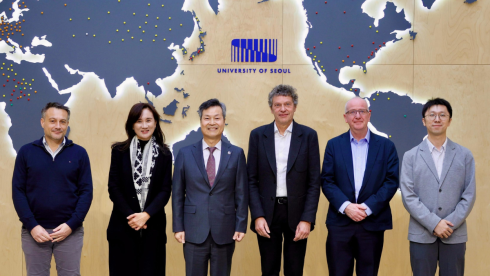
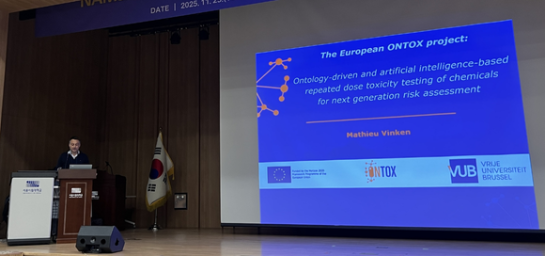
From 25 to 27 November 2025, ONTOX and fellow ASPIS projects (RISK-HUNT3R and PrecisionTox) joined leading Korean researchers, policymakers, and students at the ChemBAI 2025 International Symposium, hosted at the University of Seoul.
The event brought together more than 150 participants to exchange on the fast-evolving landscape of Next Generation Risk Assessment (NGRA), New Approach Methodologies (NAMs), AI-enabled toxicology, and international regulatory cooperation.
"By working together, Europe and Korea can accelerate the uptake of NAMs and NGRA worldwide, ensuring chemical safety assessments that are both human-relevant and future-proof.” – reflected Mathieu Vinken, ASPIS cluster coordinator for 2024–2026 and coordinator of the ONTOX project.
|
|
|
|
| |
The symposium showcased Europe’s cutting-edge efforts in mechanism-based safety assessment, digital toxicology, and regulatory implementation of NAMs under Horizon Europe.
|
|
|
|
| |
Joining Forces to Advance AI-driven Risk Assessment
 | |
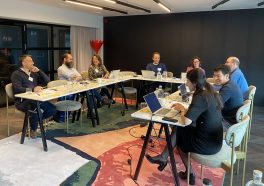
On 28–29 October 2025, ONTOX joined ECETOC and VHP4Safety in a workshop on digital infrastructures harnessing AI for health risk assessment. Regulators, scientists, and industry professionals explored how AI can be trusted, validated, and integrated into risk assessment. |
|
|
| |
| |
|
By involving end‑users early, ONTOX, ECETOC and VHP4Safety are working to ensure AI‑based tools for human health risk assessment are both scientifically robust and trusted for regulatory use.
|
|
|
|
|
| |
Young Scientists Interviews
Hear from the emerging talents advancing human-relevant, animal-free science!
|
|
|
|
| |
Rita Ortega – Polytechnic University of Valencia
 | |
Driven by a childhood curiosity for biology and technical drawing, Rita has forged her path as a researcher in computational toxicology, developing human-relevant liver toxicity models and DockTox, an automated tool for predicting organ toxicity.
|
|
|
|
|
| |
Julen Sanz Serrano – Vrije Universiteit Brussel
| |

|
Inspired early on by his mother’s healthcare career, Julen found his scientific home in toxicology. His work focuses on understanding liver toxicity and developing advanced in vitro models to support safer, animal-free chemical assessment.
|
|
|
|
|
| |
Behind the Science: How ONTOX Works
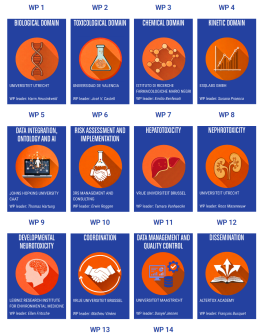
|
|
ONTOX is structured around a series of interconnected Work Packages (WPs) that drive its research, innovation, and impact. These WPs cover everything from collecting and analysing toxicological and chemical data, developing advanced mechanistic models and AI‑supported tools, to evaluating risk assessment strategies and ensuring regulatory relevance. Together, they form the backbone of the project’s strategy to deliver human‑relevant, animal‑free chemical safety assessment solutions.
|
|
|
|
|
| |
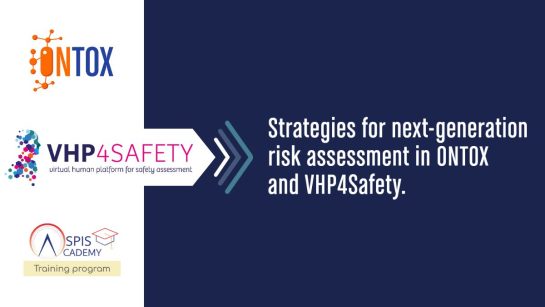
Webinar: NGRA Strategies
The fifth and final webinar in the ONTOX–VHP4Safety series will focus on strategies for Next Generation Risk Assessment (NGRA) as applied within the VHP4Safety and ONTOX projects. 📅18 December 🕒15:00–16:30 CET 💻Online 💸Free participation
Speakers: - Trine Husøy (Norwegian Institute of Public Health – NIPH | ONTOX)
- Susana Proença (ESQlabs | ONTOX)
- Julen Sanz Serrano (Vrije Universiteit Brussel | ONTOX)
- Fabian Wagenaars (TNO | VHP4Safety)
|
|
|
New ONTOX research papers
|
|
| |
A mechanistically-anchored and human stem cell-based in vitro test battery for assessing liver steatogenic potential of chemicals
Verhoeven A., Gatzios A., Rodrigues R. M., Sanz-Serrano J., De Kock J., Vinken M., Vanhaecke T.
Toxicology | December 2025
|
Machine learning classification of steatogenic compounds using toxicogenomics profiles
Bwanya B., Lodhi S., de Kok T. M., Ladeira L., Verheijen M., Jennen D., Caiment C.
Toxicology | November 2025
|
|
|
|
|
|
| |
An Alternative Safety Profiling Algorithm (ASPA) to transform next generation risk assessment into a structured and transparent process
Leist M., Tangianu S., Affourtit F., Braakhuis H., Colbourne J., Cöllen E., Dreser N., Escher S.-E., Gardner I., Hahn S., Hardy B., Herzler M., Islam B., Kamp H., Magel V., Marx-Stoelting P., Moné M. J., Lundquist P., Ottenbros I., Ouedraogo G., Pallocca G., van de Water B., Vinken M., White A., Pastor M., Luijten M.
Alternative to Animal Experimentation | October 2025
|
Unravelling drug-induced hepatic steatosis: Clinical sub-phenotypes, outcome prediction, and identification of high-concern drugs and hazardous chemical attributes
Moreno-Torres M., López-Pascual E., Moro E., Rapisarda A., Lindeman B., Verhoeven A., Luechtefeld T., Serrano-Candelas E., Dirven H., Vinken M., Castell J. V., Jover R.
Biomedicine & Pharmacotherapy | October 2025
|
|
|
|
|
|
| |
Follow us on social media!
|
|
|